

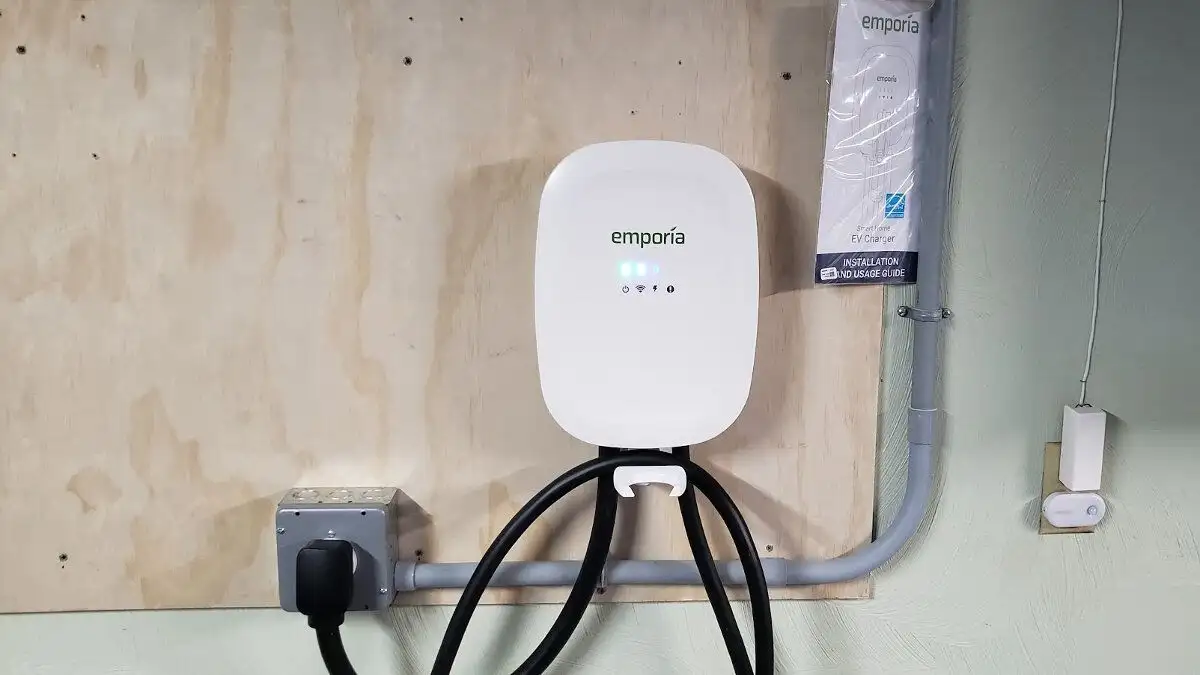
Emporia EV Charger Review,So you finally bought an electric vehicle. Congratulations you’ve joined the fastest-growing segment of the automotive world. But here’s the thing nobody warns you about: buying the car is the easy part. Figuring out how to charge it at home without spending a fortune or pulling your hair out? That’s where things get complicated.
Public charging works in a pinch but it’s slow, inconvenient and surprisingly expensive over time. Most EV owners quickly realize that home charging isn’t just convenient it’s essential. And that’s exactly where the Emporia EV charger enters the conversation.
Emporia Energy has quietly built one of the most compelling home charging solutions on the market. Smart features, competitive pricing, genuine energy management capabilities it checks boxes that pricier competitors miss. But is it actually the right home EV charger for you? Let’s find out.
What Is the Emporia EV Charger — And Who Makes It?
Before diving into specs and comparisons, it helps to understand who Emporia Energy actually is. This isn’t some overnight startup slapping together cheap hardware. There’s a real story here and it matters for understanding why their Emporia EV charging station is designed the way it is.
The Story Behind Emporia Energy
Emporia Energy launched in 2016 out of Louisville, Colorado right in the heart of a state that takes clean energy seriously. The company didn’t start by building EV chargers. They started with something smarter: home energy monitors. Their Vue Energy Monitor gave homeowners real-time visibility into exactly how much electricity every circuit in their house was consuming. It was a genuinely useful product that earned a loyal following among energy-conscious homeowners.
That foundation matters enormously. While competitors built EV chargers as standalone products, Emporia built theirs as part of a broader home energy ecosystem. The result is a smart EV charger that doesn’t just push electrons into your car it understands your home’s total energy picture and optimizes charging accordingly.“Emporia’s approach is fundamentally different. They didn’t build a charger and add smart features. They built an energy management platform and added a charger.” A sentiment echoed consistently across EV enthusiast communities.
The company’s mission making clean energy accessible and affordable for everyday Americans shows up directly in their pricing strategy. The Emporia home EV charger consistently undercuts premium competitors by $100–$200 while matching or exceeding their feature sets. That’s not accidental. It’s a deliberate market positioning choice that has earned them a devoted customer base.
The Emporia EV Charger Product Lineup
Emporia keeps their lineup refreshingly simple. No confusing model proliferation. No endless SKU variations designed to obscure pricing comparisons.
Current Emporia EV charger options:
| Model | Level | Max Output | Best For |
| Emporia Level 1 Charger | Level 1 | 12A / 120V | Plug-in hybrids, emergency backup |
| Emporia Level 2 Charger (48A) | Level 2 | 48A / 11.5kW | Daily EV charging — main product |
| Emporia Level 2 Charger (32A) | Level 2 | 32A / 7.7kW | Lower power installations |
The Emporia Level 2 charger at 48 amps is their flagship and the one this review focuses on. It’s the product that put Emporia on the map and the one that competes directly against ChargePoint, JuiceBox, and the Tesla Wall Connector.
Emporia EV Charger — Full Specifications Breakdown
Numbers tell part of the story. Context tells the rest. Here’s what the Emporia EV charger specs actually mean for your daily charging life.
Power Output and Charging Speed
The flagship Emporia Level 2 EV charger delivers up to 48 amps at 240 volts translating to 11.5 kilowatts of charging power. In practical terms, that’s roughly 37 to 44 miles of range added per hour of charging for most modern EVs.
Think about what that means overnight. Park your car at 10pm with 30% battery. Wake up at 7am. You’ve got a full charge every single morning. No range anxiety. No detours to public charging stations. Just a full battery waiting for you like a full tank of gas used to.
Real-world charging speeds by popular EV model:
| Electric Vehicle | Miles Added Per Hour (48A Emporia) | Full Charge Time (Empty to Full) |
| Tesla Model 3 (SR) | ~37 miles/hr | ~5.5 hours |
| Tesla Model Y (LR) | ~42 miles/hr | ~8 hours |
| Ford F-150 Lightning | ~30 miles/hr | ~10 hours |
| Chevy Bolt EV | ~25 miles/hr | ~7 hours |
| Hyundai Ioniq 5 | ~40 miles/hr | ~7 hours |
| Rivian R1T | ~25 miles/hr | ~14 hours |
One important nuance: your EV’s onboard charger limits maximum AC charging speed. The Emporia smart EV charger delivers up to 48A but if your vehicle’s onboard charger maxes out at 32A like some older Nissan Leafs that’s your actual ceiling. The charger meets the car at whatever the car can accept.
Connectivity and Smart Features
This is where the Emporia EV charger genuinely separates itself from budget competitors. The smart features aren’t an afterthought they’re the whole point.WiFi connectivity works on standard 2.4GHz networks the same frequency your smart thermostat and security cameras use. Setup takes about five minutes through the Emporia app. Once connected, you get:
- Real-time charging monitoring — see exactly how many kilowatts are flowing into your car right now
- Session history and energy reports — track your monthly charging costs down to the cent
- Scheduled charging — set it to only charge between 11pm and 6am when electricity rates drop
- Remote start and stop — control charging from anywhere via the app
- Notifications — get alerted when charging starts, stops, or encounters an error
The scheduling feature alone can save serious money. In most US markets, off-peak electricity rates run 40–60% cheaper than peak rates. If you’re charging a large-battery EV like a Ford Lightning every night, smart scheduling can save $400–$600 annually compared to unscheduled daytime charging.
Smart home integration options:
| Platform | Integration Type | Example Commands |
| Amazon Alexa | Native skill | “Alexa, start charging my car” |
| Google Home | Native integration | “Hey Google, stop EV charging” |
| IFTTT | Applet-based | Trigger charging based on solar production |
| Emporia App | Full control | Complete feature access |
Cable Length and Connector Type
The Emporia home EV charger comes with a 24-foot charging cable long enough to reach vehicles parked anywhere in a standard garage without awkward cable management gymnastics. This matters more than people realize until they’re standing in their garage with a 12-foot cable that won’t quite reach the charge port.The connector is the industry-standard J1772 compatible with every non-Tesla electric vehicle sold in North America. Tesla owners need a J1772 adapter which Tesla includes with every new vehicle purchase. So yes, the Emporia EV charger works with Teslas too. It just needs that small adapter.
Installation Requirements
Here’s where honest information really matters. The Emporia Level 2 charger requires a 240-volt circuit the same type of circuit your electric dryer or oven uses. If you already have a 240V outlet in your garage, you can potentially plug straight in. Most installations, however, require running a new dedicated circuit from your electrical panel.
Installation requirements at a glance:
| Requirement | Specification |
| Voltage | 240V AC |
| Circuit breaker | 60A dedicated breaker (for 48A charger) |
| Wire gauge | 6 AWG copper minimum |
| GFCI protection | Built into the charger |
| Outdoor rating | NEMA 4 (indoor/outdoor rated) |
| Mounting | Wall mount included |
The NEMA 4 rating means this charger handles rain, splashing water, and outdoor conditions without complaint. Mount it in your garage, on your carport wall, or on an exterior house wall it handles all three situations.
Emporia EV Charger vs The Competition
Shopping for a home EV charging station means comparing Emporia against three main competitors. Here’s the honest breakdown.
Emporia vs ChargePoint Home Flex
ChargePoint is the biggest name in EV charging infrastructure. Their Home Flex is polished, reliable and comes with ChargePoint’s massive charging network app integration. But you pay for that brand recognition.
The key differences:
| Factor | Emporia EV Charger | ChargePoint Home Flex |
| Max Amperage | 48A | 50A |
| Price | ~$199–$219 | ~$699 (updated 2025 pricing) |
| App Quality | Excellent | Excellent |
| Energy Monitoring | Deep integration | Basic |
| Solar Integration | Yes | Limited |
| Cable Length | 24ft | 23ft |
ChargePoint edges Emporia by 2 amps at maximum output a difference so small it’s irrelevant in daily use. Emporia wins decisively on price and energy management depth. Unless ChargePoint’s network access matters to you specifically, Emporia delivers better value.
Emporia vs JuiceBox 40
JuiceBox makes genuinely good chargers. The 40-amp JuiceBox competes directly with Emporia’s flagship and offers solid smart features through the JuiceNet app. However, the JuiceBox 40 caps at 40 amps versus Emporia’s 48 a meaningful 20% power difference that translates directly to faster charging.
For similar or higher pricing, you get less power and less sophisticated energy monitoring than the Emporia smart EV charger provides. JuiceBox is a fine product but Emporia beats it on the metrics that matter most to value-conscious buyers.
Emporia vs Tesla Wall Connector
If you drive a Tesla, the Wall Connector deserves serious consideration. It integrates natively with Tesla’s ecosystem, supports Tesla’s load-sharing between multiple connectors, and looks sleek on a garage wall. The price is competitive with Emporia.
But here’s the catch: it only works with Teslas. The moment you add a second EV from another brand or sell your Tesla and buy something else the Wall Connector becomes useless hardware. The Emporia EV charger’s universal J1772 compatibility future-proofs your investment regardless of which brand you drive next.
Full Head-to-Head Comparison
| Feature | Emporia | ChargePoint Home Flex | JuiceBox 40 | Tesla Wall Connector |
| Max Amperage | 48A | 50A | 40A | 48A |
| Max Power | 11.5kW | 12kW | 9.6kW | 11.5kW |
| WiFi | Yes | Yes | Yes | Yes |
| App Control | Yes | Yes | Yes | Yes |
| Energy Monitoring | Advanced | Basic | Moderate | Tesla only |
| Solar Integration | Yes | No | Limited | No |
| Cable Length | 24ft | 23ft | 25ft | 18ft |
| Universal Compatibility | Yes | Yes | Yes | Tesla Only |
| Approximate Price | ~$200 | ~$699 | ~$399 | ~$400 |
| Outdoor Rated | Yes | Yes | Yes | Yes |
The value case for Emporia is difficult to argue against. At roughly one-third the price of ChargePoint with comparable or superior features the Emporia EV charger wins the value calculation for most home charging buyers.
Emporia Smart EV Charger — App and Smart Features Deep Dive
Smart home EV chargers live and die by their software. Hardware is hardware. Software determines whether you actually use the smart features or ignore them entirely.
The Emporia App — How It Actually Works
Setup is genuinely straightforward. Download the Emporia app, create an account, plug in the charger, connect it to your home WiFi and you’re done. The whole process takes under ten minutes for most users.
The dashboard gives you an immediate view of:
- Current charging session — kilowatts flowing, miles added, session cost
- Historical data — daily, weekly, monthly charging summaries
- Cost tracking — enter your electricity rate and Emporia calculates exact charging costs automatically
- Scheduling interface — drag-and-drop time blocks for off-peak charging windows
The app is available on both iOS and Android and receives regular updates. Unlike some competitors whose apps feel like afterthoughts, Emporia clearly invests in the software side of their product. User reviews consistently rate the app experience as one of the charger’s strongest features.
Energy Management and Load Balancing
This is Emporia’s genuine superpower the capability that no competitor at this price point matches.
When paired with the Emporia Vue Energy Monitor (sold separately), the Emporia home EV charger gains the ability to see your home’s total electrical load in real time. If your air conditioning kicks on during a hot afternoon, the system automatically reduces charging amperage to prevent tripping your main breaker. When the AC cycles off, charging ramps back up. Your car charges as fast as possible without ever overloading your home’s electrical system.
Why this matters practically:
- Older homes with smaller electrical panels (100A service) can safely run a 48A charger without panel upgrades
- No need to manually manage charging around high-consumption appliances
- Solar panel owners can maximize self-consumption by charging when solar production peaks
“The load balancing feature saved me from a $3,000 panel upgrade. The Emporia charger works perfectly with my existing 100-amp service.” Verified customer review, widely cited in EV owner forums.
For solar panel owners specifically, the Emporia ecosystem integration is remarkable. Set the system to prioritize solar charging the charger automatically increases output when your panels produce surplus energy and reduces output when clouds cut production. You’re essentially driving on sunshine at zero marginal cost.
Voice Control and Smart Home Integration
Voice commands work reliably through both Alexa and Google Home once the initial linking is complete. The commands are intuitive rather than technical “start charging,” “stop charging,” “what’s my charging status” all work as expected.
Practical IFTTT automation examples:
- Start charging automatically when you arrive home (location trigger)
- Stop charging when solar production drops below a threshold
- Send a notification if charging doesn’t start by a set time
- Pause charging when whole-home energy use exceeds a limit
Installing the Emporia Home EV Charger — What to Expect
Installation reality often differs from installation marketing. Here’s what genuinely happens.
DIY vs Professional Installation
You can potentially DIY the installation if:
- You have genuine electrical experience
- Your panel has capacity for a new 60A breaker
- Local codes permit homeowner electrical work
- You’re comfortable working in a main electrical panel
You should hire a licensed electrician if:
- You have no electrical experience whatsoever
- Your panel is at capacity or showing its age
- Local permits require licensed contractor sign-off
- You’re installing outdoors with conduit work required
Average professional installation cost runs $200–$900 depending on panel proximity, conduit requirements, and local labor rates. Factor this into your total budget alongside the charger’s purchase price.
The good news: the 30% federal tax credit (Form 8911) covers both the charger hardware and installation labor costs. A $200 charger plus $500 installation totals $700 the tax credit returns $210 directly. That’s a meaningful real-world discount.
Step-by-Step Installation Overview
What’s in the Emporia EV charger box:
- The charger unit with integrated 24-foot cable
- Wall mounting bracket and hardware
- Quick start guide
- NEMA 14-50 plug (on plug-in models)
Basic installation sequence:
- Choose mounting location near panel, accessible to vehicle charge port
- Run 240V circuit with appropriate wire gauge from panel
- Install 60A dedicated breaker in panel
- Mount charger bracket to wall
- Connect wiring (hardwired) or plug into NEMA 14-50 outlet (plug-in)
- Mount charger unit on bracket
- Power on connect to WiFi through Emporia app
- Test with vehicle
Common Installation Mistakes to Avoid
- Undersized wire gauge — always use 6 AWG copper minimum for 48A charger. Anything smaller creates a fire hazard
- Shared circuit — the charger needs its own dedicated breaker. Never share with other appliances
- Wrong breaker size — a 48A charger needs a 60A breaker (80% rule for continuous loads)
- Ignoring permits — skipping permits can void homeowner’s insurance and complicate future home sales
- Poor mounting location — mount at a height where the cable reaches your charge port comfortably without strain
Real World Performance — Emporia EV Charger in Daily Use
Specifications describe potential. Real-world use reveals truth.
Charging Speed in Real Life
Across thousands of verified user reports, the Emporia Level 2 charger consistently delivers its rated output. There’s no significant throttling, no mysterious speed reductions after extended sessions, no thermal cutbacks under normal conditions.
Typical overnight charging scenario:
- Vehicle: Tesla Model Y Long Range (82 kWh battery)
- Start: 10:30pm, 25% battery remaining
- Emporia output: 48A / 11.5kW
- Result: 100% charge by 6:00am
- Energy added: ~62 kWh
- Cost at $0.12/kWh off-peak rate: ~$7.44
Compare that to a public Level 2 charger at $0.35/kWh the same charge costs $21.70. The Emporia home EV charger pays for itself in public charging savings within three to six months for daily drivers.
Reliability and Durability Over Time
Emporia backs the charger with a 3-year warranty covering defects in materials and workmanship. User-reported failure rates are low the most commonly cited issues involve WiFi connectivity glitches (usually resolved by a firmware update) rather than hardware failures.
What the warranty covers:
- Manufacturing defects
- Component failures under normal use
- Software issues affecting functionality
What it doesn’t cover:
- Physical damage from accidents
- Damage from improper installation
- Normal wear on the charging cable
User Reviews and Community Feedback
Pulling from verified purchase reviews across major platforms, the Emporia EV charger consistently earns 4.3–4.6 out of 5 stars. The pattern in positive reviews is remarkably consistent:
What owners love:
- Price-to-performance ratio “nothing else comes close at this price”
- App reliability and feature depth
- Load balancing with Vue energy monitor
- Build quality that exceeds price expectations
- Responsive customer support
Most common complaints:
- Occasional WiFi disconnection requiring app reconnect
- Cable could be more flexible in cold weather
- There is no built-in cable holder on the device itself.
- Some users report app needing occasional manual refresh
None of the common complaints are dealbreakers. They’re refinement issues on an otherwise strong product.
Is the Emporia EV Charger Worth the Money?
Let’s talk numbers honestly.
Pricing Breakdown
| Cost Item | Typical Range |
| Emporia 48A EV Charger | $199 – $219 |
| Professional installation | $200 – $900 |
| Electrical permit | $50 – $200 |
| Total installed cost | $449 – $1,319 |
| Federal tax credit (30%) | -$135 to -$396 |
| Net out-of-pocket cost | $314 – $923 |
Compare that net cost against a ChargePoint Home Flex installed often $900–$1,400 total and the Emporia value proposition becomes impossible to dismiss.
Federal Tax Credits and Rebates
The Alternative Fuel Vehicle Refueling Property Credit (IRS Form 8911) covers 30% of total EV charger installation costs hardware plus labor — up to $1,000 for residential installations. This applies to Emporia EV charger purchases when installed at your primary residence.
Additional savings opportunities:
- State incentives — California, New York, Colorado and many others offer additional rebates of $250–$500
- Utility company rebates — many utilities offer $100–$500 rebates for installing smart chargers that support demand response programs
- Time-of-use rate plans — switching to your utility’s EV rate can cut charging costs 40–60%
Stack federal credit plus state rebate plus utility rebate and your Emporia home EV charger can effectively cost under $100 installed. That’s not marketing math that’s real money available to real homeowners right now.
Long-Term Value Analysis
Five-year cost comparison — home charging vs public charging:
| Charging Method | Cost Per kWh | Annual Cost (12,000 miles) | 5-Year Total |
| Emporia home charger (off-peak) | $0.08–$0.12 | $300–$450 | $1,500–$2,250 |
| Home charging (standard rate) | $0.13–$0.18 | $490–$680 | $2,450–$3,400 |
| Public Level 2 charging | $0.30–$0.45 | $1,130–$1,700 | $5,650–$8,500 |
| DC Fast Charging | $0.40–$0.65 | $1,500–$2,450 | $7,500–$12,250 |
The Emporia EV charging station pays for itself in public charging savings within months then continues saving hundreds annually for years afterward.
Who Should Buy the Emporia EV Charger?
Perfect For These Buyers
- Daily commuters who need a reliable full charge every morning without thinking about it
- Solar panel owners who want to maximize self-consumption and charge on sunshine
- Smart home enthusiasts who want their charger integrated into their broader home automation setup
- Budget-conscious EV owners who refuse to overpay for brand names when better value exists
- Multi-EV households needing load balancing to avoid panel upgrades
- Homeowners with older electrical panels who need intelligent load management
Maybe Look Elsewhere If…
- You own only a Tesla and want native ecosystem integration , the Tesla Wall Connector is worth considering
- You need DC fast charging , no home Level 2 charger including Emporia provides this. You need a commercial Level 3 setup
- You rent your home and can’t perform electrical modifications , check with your landlord first
- Your garage has poor WiFi coverage , the smart features require stable WiFi to function properly
- You need 24/7 phone support , Emporia’s support is good but not instant
Common Inquiries Regarding the Emporia EV Charger
How fast does the Emporia EV charger charge?
At maximum 48A output the Emporia EV charger adds approximately 37–44 miles of range per hour depending on your vehicle. Most EVs reach a full charge overnight in 6–10 hours.
Is the Emporia EV charger compatible with all electric vehicles?
Yes, the J1772 connector works with every non-Tesla EV sold in North America. Tesla owners use the included J1772 adapter that comes with their vehicle. The Emporia Level 2 charger is genuinely universal.
Can I install the Emporia charger myself?
Potentially yes, if you have electrical experience and local codes permit homeowner installation. Most buyers benefit from professional installation to ensure safety, code compliance, and warranty protection.
Does the Emporia EV charger work with solar panels?
Yes, and this is one of its strongest features. Paired with the Emporia Vue Energy Monitor, the Emporia smart EV charger automatically maximizes charging during peak solar production periods.
What warranty does the Emporia EV charger come with?
Emporia provides a 3-year limited warranty covering manufacturing defects and component failures under normal use conditions.
Is the Emporia EV charger outdoor rated?
Yes. The NEMA 4 rating means it handles rain, splashing water, dust, and outdoor temperature extremes. Mount it indoors or outdoors with equal confidence.
Final Verdict — Should You Buy the Emporia EV Charger?
Here’s the straight answer: for most home EV charging buyers the Emporia EV charger is the smartest purchase available right now.
It delivers 48 amps of genuine charging power. The app works reliably and improves regularly. The energy management features particularly load balancing and solar integration are genuinely useful rather than marketing gimmicks. And the price undercuts the competition so dramatically that the value case is almost embarrassingly clear.
Buy the Emporia EV charger if you want maximum charging speed, smart energy management, universal EV compatibility, and professional-grade features at a price that doesn’t require financing.
Consider alternatives if you’re a Tesla-exclusive household or need features that only brand-specific ecosystems provide.
The Emporia home EV charger won’t win any design awards. It doesn’t have the premium finish of a ChargePoint or the seamless Tesla integration of a Wall Connector. But it does the actual job charging your car quickly, intelligently, and affordably better than anything else at its price point.Sometimes the best product isn’t the most famous one. Sometimes it’s just the one that works exceptionally well and doesn’t cost a fortune. The Emporia EV charging station is exactly that.